
![[icon]](https://static.twoday.net/noctua/images/icon.jpg "[icon]")
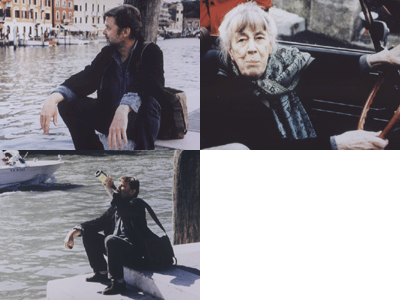
Im Kino gewesen. Es ist zwar schon wieder zwei drei Tage her, lohnt sich aber noch zu berichten. Montag Morgen ist ein Film ohne Handlungsbogen. Die einzelnen Episoden werden durch die Personen, vor allem Vincent, zusammengehalten. Viel Alltag, einige Klischees, einige Überrschaschungen. Das Leben besteht zwar vor allem aus dem immer gleichen Montag Morgen, aber es gibt manchmal eben doch auch Ereignisse, die das ganze lebenswert machen.
Samstag, 22. Februar 2003, 12:06 - Rubrik: Und sonst so
There is an article about THC and the history of THC research at AlterNet. “In fact, the pleasures derived from marijuana, sex and chocolate are all tied together by similar chemical reactions in our brains.” (via SciTech Daily)
Freitag, 21. Februar 2003, 14:22 - Rubrik: Forschung
Onur Güntürkün hat festgestellt, daß mehr Menschen den Kopf beim Küssen nach rechts als nach links neigen. Dazu hat er Paare auf öffentlichen Plätzen beobachtet. Ich plädiere für einen Ignobel-Preis. Trotzdem, Herr Güntürkün, herzlichen Glückwunsch zu der Publikation in Nature. (via SciTech Daily)
p. s.: Addendum (Oder: “Wie mache ich mich endgültig lächerlich?”)
p. s.: Addendum (Oder: “Wie mache ich mich endgültig lächerlich?”)
Donnerstag, 20. Februar 2003, 17:16 - Rubrik: Forschung
Ein Gespräch mit Stanislaw Lem in der F. A. Z von heute. Lem gallig, fast misanthrop. “Da denke ich mir nur: Bitte, setzt euch in die Panzer und greift an!” (Irak) – “Es ist einfacher, eine große Perle auf dem Trottoir zu finden als einen guten Roman von einem Fünfundzwanzigjährigen.” (allgemein) – “Der Mensch ist eine unangenehme Gattung, sehr peinlich, ja.” (noch allgemeiner) – Privatkopie anlegen, bevor der Text im teuren Archiv verschwunden ist! (via Perlentaucher, nämlich hier)
Mittwoch, 19. Februar 2003, 11:33 - Rubrik: Autor
… und die Ordnung der Natur ist ein Buch über die Fundstücke in Naturaliensammlungen des späten Mittelalters und während der Aufklärung. In der taz rezensiert von Rebekka Habermas. Das englische Original erschien 1998 bei Zone Books und ist für etwa EUR 40 noch im Handel. (via Perlentaucher, nämlich hier)
Dienstag, 18. Februar 2003, 14:02 - Rubrik: Buch
I realize that nothing I say matters to anyone else on the entire planet. My opinions are useless and unfocused. I am an expert in nothing. I know nothing. I am confused about almost everything. I cannot, as an individual, ever possibly know everything, or even enough to make editorial commentary on the vast vast majority of things that exist in my world. This is a stupid document; it is meaningless drivel that I do not expect any of the several billion people on my planet to actually read. People who do read my rambling, incoherent dumbfuckery are probably just as confused as I am, if not moreso, as they are looking to my sorry ass for an opinion when they should be outside playing Frisbee with their dog or screwing their life partner or getting a dog or getting a life partner. Anyone who actually takes the time to read my bullshit probably deserves to ingest my fucked up and obviously mistaken opinions on whatever it is that I have written about.
Signed: -noctua-
I am indebted to “Why I Fucking Hate Weblogs!” for this wonderful formulation. (via smi)
Signed: -noctua-
I am indebted to “Why I Fucking Hate Weblogs!” for this wonderful formulation. (via smi)
Dienstag, 18. Februar 2003, 08:57
Telepolis berichtet über den “Plan for the National Digital Information Infrastructure and Preservation Program”. Die Kongressbibliothek will also digitale Daten retten und bewahren. James H. Billington: “Vieles, was geschaffen worden ist, ist nicht mehr zugänglich […] Und viel von dem, was verschwindet, ist wichtiges einmaliges Material, das niemals wieder reproduziert werden kann, sondern nach dem man verzweifelt suchen wird.” Mag gut sein. Aber da wäre ich doch neugierig auf die Selektionskriterien. Bislang wurden schon einmal Websites vom Präsidentschaftswahlkampf im Jahr 2000 gespeichert. Die Menschheit wird dir auf ewig dankbar sein, Kongressbibliothek!
Dienstag, 18. Februar 2003, 08:43 - Rubrik: Digitale Dokumente
I just found out (via some pages about Daniel Dennet's new book on the same matter) about a book from Derk Pereboom: Living Without Free Will. There is a review in Notre Dame Philosophical Reviews.
Montag, 17. Februar 2003, 15:26 - Rubrik: Buch
Richard Holloway tells us about Richard Dawkins new book in the Guardian. A Devil's Chaplain & Other Selected Essays. “The goal of life is life itself. There is no final purpose, no end other than entropy and the end of all endings.” Yes, O. K. “But there is deep refreshment to be had ‘from standing up full-face into the keen wind of understanding’.” Mh, maybe, sometimes. Dawkin's earlier book River out of Eden was of the boring kind though. (via Arts & Letters Daily)
p. s.: There's a read-worthy portrait of “the devil's chaplain” in the Guardian by Simon Hattenstone. Two quotes: “In one of the letters that he [Dawkins] regularly fires off to newspapers, he suggested that child sex abuse in the Church ‘unpleasant as it is, may do less permanent damage to the children than bringing them up Catholic in the first place’.” This is not so far away from the truth, I think. — “I see religion, however, as a kind of organised misconception.” Here he is wrong because religion is not about conception, or is it? (via SciTech Daily)
p. s. Gould and God, a review of A Devil's Chaplain in Nature.
p. s. Through a Glass, Darkly. A thoughtfully written review by Michael Ruse in the American Scientist.
p. s. The concept of cultural items such as tunes or games, beliefs or fashions, as themselves “memes” with a kind of life of their own, making use of human beings as vehicles in their pitiless Darwinian struggle with competitors, has similar problems. First it sounds perverse, but then it seems dazzling and exciting. Yes! A gunman is a bullet's way of making another bullet, and a librarian is a library's way of making another library! Like Samuel Butler, who instructed that “even a potato in a dark cellar has a low cunning that stands it in excellent stead,” we suddenly think of tunes and games and accents and treatments as pursuing their own projects, plotting to invade us, making use of us to pursue their own competitive existences. Again, though, there is the sobering up. Get rid of any image of a tune or a treatment cunningly squirreling away, invading people and bringing about changes. A tune does not literally make use of people, since it is not the kind of thing that has purposes and designs. What is true is that when one lodges in people's heads, they are prone to spread it. And then we feel let down, since this is all that is apparently left when the rhetorical flourishes are cleaned off.
From a review by Simon Blackburn in The New Republic online. I feel alike.
p. s.: There's a read-worthy portrait of “the devil's chaplain” in the Guardian by Simon Hattenstone. Two quotes: “In one of the letters that he [Dawkins] regularly fires off to newspapers, he suggested that child sex abuse in the Church ‘unpleasant as it is, may do less permanent damage to the children than bringing them up Catholic in the first place’.” This is not so far away from the truth, I think. — “I see religion, however, as a kind of organised misconception.” Here he is wrong because religion is not about conception, or is it? (via SciTech Daily)
p. s. Gould and God, a review of A Devil's Chaplain in Nature.
p. s. Through a Glass, Darkly. A thoughtfully written review by Michael Ruse in the American Scientist.
p. s. The concept of cultural items such as tunes or games, beliefs or fashions, as themselves “memes” with a kind of life of their own, making use of human beings as vehicles in their pitiless Darwinian struggle with competitors, has similar problems. First it sounds perverse, but then it seems dazzling and exciting. Yes! A gunman is a bullet's way of making another bullet, and a librarian is a library's way of making another library! Like Samuel Butler, who instructed that “even a potato in a dark cellar has a low cunning that stands it in excellent stead,” we suddenly think of tunes and games and accents and treatments as pursuing their own projects, plotting to invade us, making use of us to pursue their own competitive existences. Again, though, there is the sobering up. Get rid of any image of a tune or a treatment cunningly squirreling away, invading people and bringing about changes. A tune does not literally make use of people, since it is not the kind of thing that has purposes and designs. What is true is that when one lodges in people's heads, they are prone to spread it. And then we feel let down, since this is all that is apparently left when the rhetorical flourishes are cleaned off.
From a review by Simon Blackburn in The New Republic online. I feel alike.
Montag, 17. Februar 2003, 15:07 - Rubrik: Buch
Buch gelesen: Epsilon von David Ambrose. Mehr in meiner Liste B
Samstag, 15. Februar 2003, 22:35 - Rubrik: Buch